Routing Internals
This page is for contributors changing the routing engine. It explains how a router runs the endpoint it chose, how one router can hand a request to another, and the experimental composition built on that. Nothing here needs configuring to run a gateway; Routing covers what does.
The short version: a router picks an endpoint and then calls that endpoint’s adapter through a thin wrapper called a leaf, which runs exactly the adapter the router picked and nothing else. A pool is the other kind of wrapper: it hands the request to a second router that makes its own choice within a limited set of endpoints. Every router in use today executes through leaves; pools are used only by the opt-in composition described at the end.
How a request reaches an adapter
A router owns selection, admission, retries, and feedback. Once it chooses an
endpoint, it creates an EndpointBinding holding the selected adapter, and a
LeafBackend calls that adapter. A TreeBackend provides a different capability:
it delegates to a router inside a declared candidate pool. The wrapped router
keeps its own selection and execution flow. See
Leaves, pools, and dispatch instructions.
Startup wiring lives in apps/backend/serving/servers/bootstrap.py: it
registers routes from the model registry into one process-scoped
FixedRouter, optionally applies the RoutingManager, then builds a
ModelRouterRegistry over the same route table. Routers for every known model
are constructed eagerly at boot, so a bad strategy name or bad router_params:
is reported at startup rather than on the first request. What the registry
returns for a model depends on its router: field:
routewise— aRouteWiseRouterover the model’s full candidate pool, local and cloud alike.fixed— the sharedFixedRouter, unless the model opts in to composition withrouter_params.hybrid_composition: trueand has both local and cloud candidates. In that caseapps/backend/serving/servers/hybrid_composition.pybuilds aHybridRouterover aLocalBackendand a cloud backend instead. All-local and all-cloud models keep the sharedFixedRoutereven when the option is enabled.
The leaf execution boundary is already used by ordinary Fixed and RouteWise. Existing configurations use these paths without enabling composition:
FixedRouter     -> LeafBackend -> selected Adapter
RouteWiseRouter -> LeafBackend -> selected Adapter
Both routers can select from local and cloud endpoints in the same model’s
route. hybrid_composition enables the additional HybridRouter layer that
plans across separate local/cloud pools; it is not required to use either the
leaf boundary or a mixed candidate pool.
Leaves, pools, and dispatch instructions
LeafBackend uses the adapter’s call signature and directly forwards its
chat call or stream iterator. It does not implement the router-shaped
RoutingBackend protocol. Pool wrappers such as TreeBackend implement that
protocol and forward requests to a scoped router.
For composed dispatch, HybridRouter uses two explicit instructions
(apps/backend/routing/dispatch.py) to state what a pool may do:
Instruction |
Permission |
Pool behavior |
|---|---|---|
|
Execute exactly the bound endpoint. |
|
|
Select inside the named pool. |
|
An exact dispatch can therefore pass through a child router for admission;
the instruction limits that router to the bound endpoint. check_dispatch()
and the pool’s request validation reject a wrong pool, an excluded model, or an
out-of-scope binding before upstream I/O. Such composition errors propagate
without fallback or a provider failure sample. A leaf has no pool-selection
capability and cannot carry out DelegatePool.
EndpointBinding carries the endpoint id, the model, the pool, a diagnostic
route-table generation, and the adapter itself. Holding the adapter is the
point: execution does not look the target up a second time, so an admin route
edit cannot redirect a request that is already in flight. Binding and leaf
construction both reject an inconsistent endpoint identity, and a leaf refuses a
composite executor that reports outcomes for several endpoints at once. Each
hedge leg gets its own leaf. If a RouteWise candidate has been replaced by a
different adapter object for the same endpoint, RouteWise rejects the old
binding before reserving capacity: admission and execution must use the same
adapter. generation is diagnostic only; it does not decide whether a binding
is stale.
Accounting stays with the owning router. Selection, the admission claim, the prefill
lease, retry and hedge bookkeeping, _routing metadata, and the feedback handed
to record_observation() all stay with the router that chose the endpoint. A
leaf adds no second copy of this state or accounting.
Pool scopes constrain selection and fallback. LocalBackend and
FixedCloudBackend enforce model grants and narrow RoutingRequestOptions.endpoint_scope
before forwarding to the shared router. RouteWiseCloudBackend also binds a
RouteScopeView (route_scope.py), keeping the child router’s candidate
selection, retries, hedge legs, and active probes inside its cloud range.
Provider labels are expanded to canonical endpoint ids within the requested
model before scopes are compared. A caller’s scope can narrow the pool’s grant;
an empty intersection is refused, never treated as unrestricted access.
Requests keep the router API. Calls use chat_completion() or
stream_chat_completion() with routing_options. For each composed attempt,
dispatch_for_attempt() constructs the instruction; the resolved binding,
scope, and target/fallback controls travel through RoutingRequestOptions to
the child router. A preferred endpoint allows selection of another candidate
unless require_target is set. allow_fallback controls retries after an
executed attempt fails.
Admission refusal does not report an upstream failure. A configured pool
with no available capacity can raise TargetUnavailableError. HybridRouter
then tries the next permitted attempt; a successful fallback is returned normally.
If all attempts are refused without reaching an upstream, the final refusal
maps to 503. A streaming response whose headers have already been sent
carries code 503 in its SSE error instead of changing the HTTP status.
If upstream attempts did fail, the router’s error-selection rules determine
the final error.
Composition is opt-in per model, and off by default:
router: fixed
router_params:
  hybrid_composition: true
Its affinity updates, its re-selection after a rejected primary claim, and its
fallback circuit timing are not yet proven equivalent to the original Fixed
loop, so the default entry point stays the shared FixedRouter until they are;
see #1457. Pins
from the HTTP API and the admin playground keep using the shared FixedRouter
regardless.
Candidate scopes do not divide physical capacity. Each RouteWiseRouter still
owns its resource managers; sharing a constrained pool across independent
instances and rejecting unsupported duplicate-pool configurations remain
deferred to the same issue.
Router types and execution boundaries
Routing also has a composition implementation, HybridRouter
(apps/backend/routing/hybrid.py), which plans across a local and a cloud pool
and delegates each attempt to a TreeBackend. It is not a third router:
value: a router: fixed model opts in with
router_params.hybrid_composition: true, and composition is built only when
both local and cloud candidates exist. Every other fixed model keeps the shared
FixedRouter, and routewise models keep their own entry point and full
candidate pool. The ordinary Fixed and RouteWise paths already execute through
LeafBackend; enabling composition is a separate choice.
The pool side exists so that one algorithm can own admission for a domain while a different algorithm owns selection inside it, with neither one enumerating the other’s endpoints.
The diagrams below adapt the composable routing design into a map of the current implementation and its planned extensions. The first shows type relationships; the following three show request paths. A dashed box or edge marks something that does not exist yet.
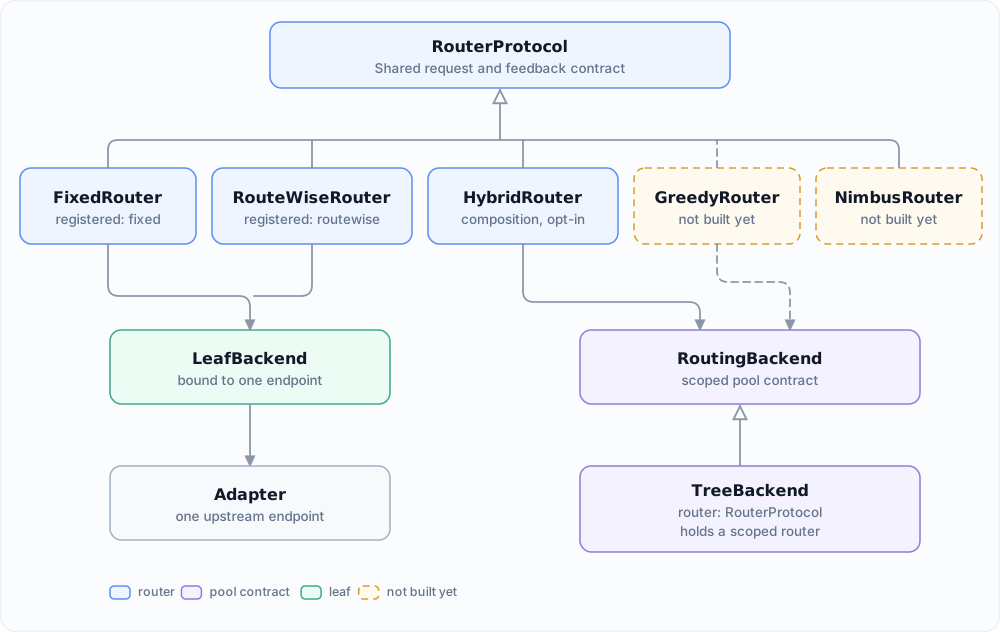
Router contracts and endpoint execution. Dashed boxes and edges mark what is not built yet.
FixedRouter and RouteWiseRouter are peer implementations of RouterProtocol;
future GreedyRouter and NimbusRouter belong at that same level. HybridRouter
sits there too, as a composition rather than a strategy: it selects no endpoint
itself and hands every attempt to a pool. Each router keeps its own selection,
admission, retry and feedback flow. LeafBackend binds one adapter
and executes it. It uses the adapter’s calling convention and does not implement
the router-shaped RoutingBackend protocol, which is what makes a leaf the end
of the recursion. TreeBackend implements that pool protocol and holds a scoped
router; the held router can be RouteWise without making RouteWise a different
kind of strategy.
Full-pool RouteWise: available today
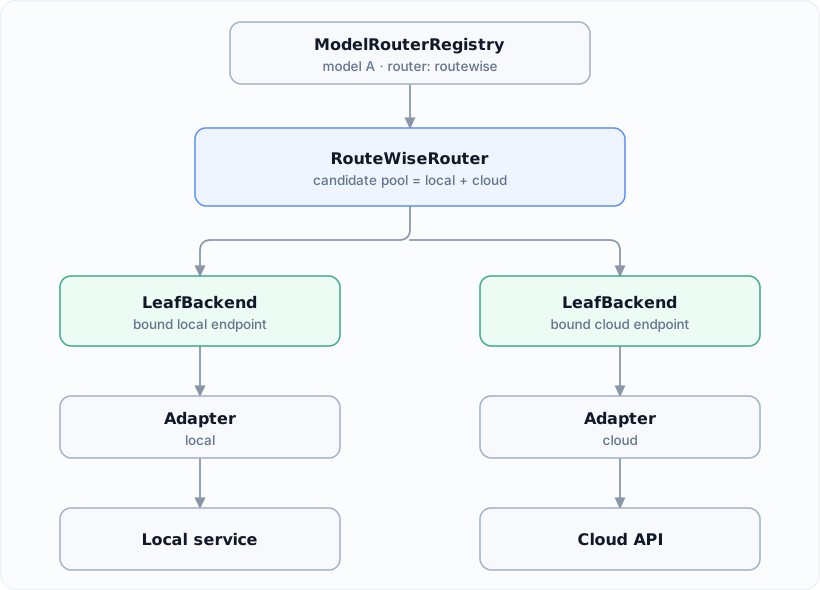
Full-pool RouteWise selects across local and cloud candidates directly.
With router: routewise, the registry returns RouteWiseRouter directly. It
keeps the model’s full candidate pool, reservations, re-solving, hedging and
learning. The two branches show possible endpoints, not a requirement to call
both: each actual attempt or hedge leg executes its own bound leaf. The ordinary
router: fixed path also uses FixedRouter → LeafBackend → Adapter, without
enabling composition.
Fixed composition: explicitly enabled
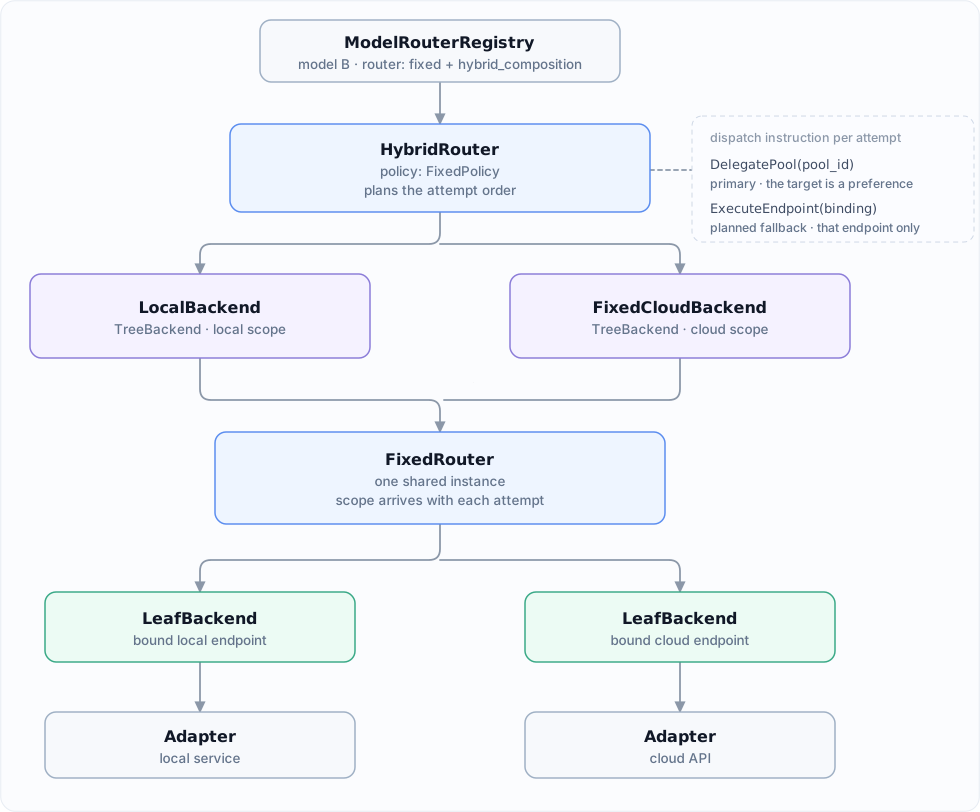
Current Fixed composition: two scoped pool wrappers, one shared FixedRouter.
A mixed router: fixed model enters this path only with
router_params.hybrid_composition: true and both local and cloud candidates.
HybridRouter uses FixedPolicy to plan attempts; LocalBackend and
FixedCloudBackend forward their scope and dispatch constraints to the same
shared FixedRouter. The shared instance does not erase those per-attempt
restrictions. Admission and health accounting remain in the router; the leaf
executes the bound adapter.
Each attempt carries one of the two instructions in
apps/backend/routing/dispatch.py, which is what makes it a requirement rather
than a suggestion. The primary attempt is a DelegatePool(pool_id): the policy’s target
travels with it as a preference, and the pool may select something else inside
its own scope. Every planned fallback is an ExecuteEndpoint(binding) — that
endpoint and no other — so the child router cannot reorder the candidates the
composition has committed to. Either way the instruction is checked before any
upstream I/O, and a pool that cannot carry it out reports a composition error
instead of falling back. The full table is in
Leaves, pools, and dispatch instructions.
This is the concrete composition class, not the common router interface. Its affinity, its re-selection after a rejected primary claim and its fallback circuit timing were never shown equivalent to the ordinary Fixed path — #1457 enumerates the differences — which is why composition stays opt-in instead of becoming the default.
Greedy with cloud RouteWise: future extension
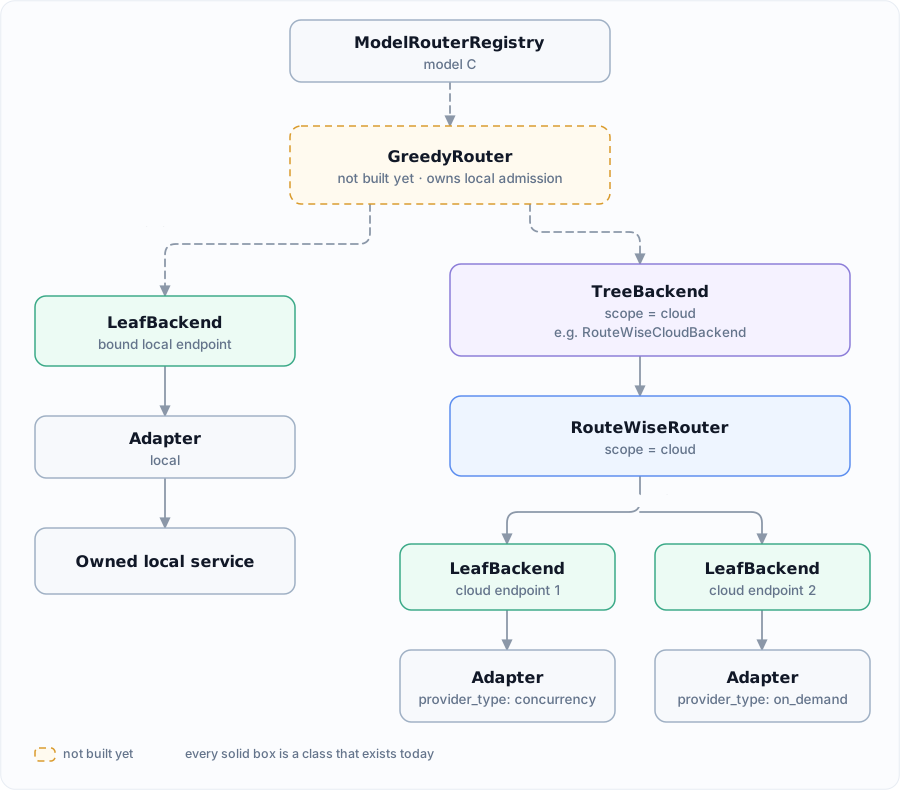
Planned topology, not an available router configuration: Greedy would own local admission; RouteWise would own selection inside the cloud pool.
The same RouteWiseRouter implementation can occupy the model’s entry point
in the full-pool diagram or a cloud-scoped position here. Those roles use
separate instances with their own scopes; a live instance is not switched
between scopes per request. After local admission is refused, a future Greedy
router can delegate cloud selection to a TreeBackend, whose inner RouteWise
router owns cloud selection, retries and hedging.
What is missing is the entry point, not the pool below it. TreeBackend and
RouteWiseCloudBackend are in apps/backend/routing/backends.py today, and
HybridFixedRouterFactory already accepts a cloud_backend builder
(apps/backend/serving/servers/hybrid_composition.py), so a composition root
can put a cloud-scoped RouteWise under a pool right now. GreedyRouter and
NimbusRouter are not registered strategies, and no models.yaml field names
one, so nothing reaches this shape from configuration.
This example describes two routing levels, not arbitrary recursive
configurations. Sharing physical quota or concurrency across independent router
instances would also need an ownership implementation nobody has written:
separate scopes do not create separate capacity, and #1457 scopes
what that would take. Local/cloud ownership stays independent of the
provider_type values on_demand, quota and concurrency.